

Club Profile
València
A historical giant of Spanish football now struggling with ineffective ownership, València still boasts one of the great stadiums and atmospheres in the country — plus it’s in a wonderful beachside city.
LOCATION: València, on the east coast of Spain about two hours by train from Madrid and three hours from Barcelona.
CONTACT: valenciacf.com, (00 34) 96 337 26 26, #VCFMestalla
NICKNAMES: Los Murciélagos (The bats)
València History
Valencia Club de Fútbol was founded in March 1919 and began building its identity in the early decades of Spanish football, moving into the iconic Mestalla Stadium shortly after its founding in 1923. Early regional success allowed the club to enter national competitions, laying the foundations for future prominence.
Valencia’s first golden age arrived in the 1940s, when the club emerged as a powerhouse of Spanish football, winning three La Liga titles and two Copa del Rey trophies. This period was the most successful in club history and firmly established Valencia among the elite.
Although the club could not fully replicate that dominance in the 1950s, it continued to grow, expanding Mestalla and attracting high-profile players such as Antonio Puchades and Faas Wilkes. Domestic cup success returned in 1954, and in the 1960s Valencia made its mark on the European stage by winning the Inter-Cities Fairs Cup twice in succession, underlining its international credentials even as league form remained inconsistent.
The 1970s and early 1980s brought renewed domestic and European success. Under coach Alfredo Di Stéfano, Valencia won La Liga in 1971, while the era of Mario Kempes produced further trophies, including the Copa del Rey, the European Cup Winners’ Cup, and the UEFA Super Cup. This success was followed by a sharp decline in the mid-1980s, as financial instability and internal problems culminated in the club’s first relegation from La Liga in 1986. Valencia recovered quickly, regaining top-flight status and stabilizing through the late 1980s and 1990s.
The club’s most successful modern period came in the late 1990s and early 2000s, when Valencia won multiple major honors, including two La Liga titles, a UEFA Cup, and a UEFA Super Cup, while also reaching back-to-back UEFA Champions League finals in 2000 and 2001. (They lost the first, 3-0, to Real Madrid, and the second to Bayern Munich on penalties.)
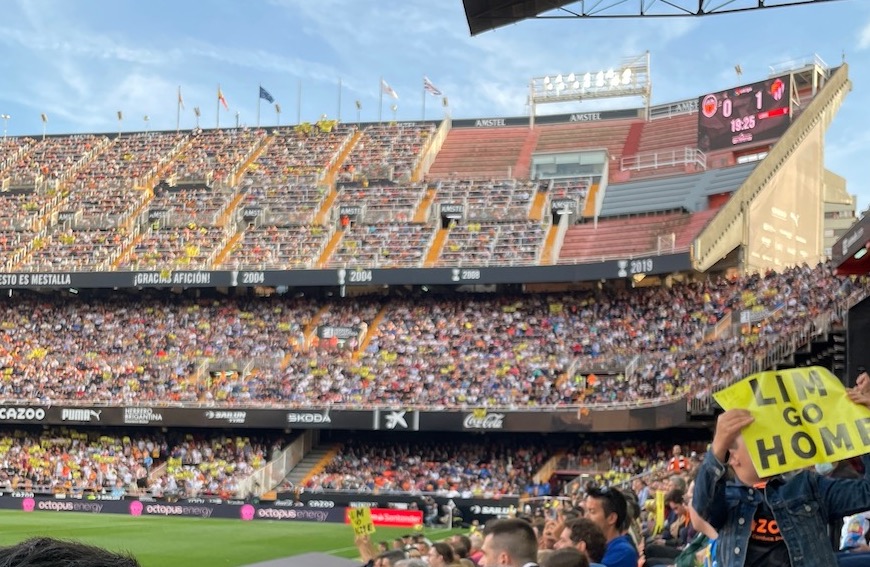
Known for tactical discipline and a strong team ethic, this era defined Valencia as one of Europe’s top sides. In more recent years, despite notable achievements such as Copa del Rey victories in 2008 and 2019, Valencia has faced recurring financial problems, frequent managerial changes, and declining competitiveness under Peter Lim’s ownership. This has led to repeated protest and chants of “Lim go home.”
Even so, the club’s history remains defined by resilience, periods of elite success, and a deep-rooted place in Spanish football culture. And their stadium and atmosphere are absolutely special.
2024-25 SEASON: 12th in La Liga, Copa del Rey quarterfinal
2025-26 SEASON: La Liga (39th season in a row)
València Rivalries
Valencia shares the Derbi del Turia with Levante, with their first match being played over 100 years ago in 1920. It took over 40 years for the two to meet in La Liga and since then, Valencia holds the edge in the rivalry with 22 wins from 39 meetings. Valencia holds extreme homefield advantage in this derby, with Levante’s last win at the Mestalla coming in 1937.
The much newer rivalry — probably one of the youngest in Europe — is the Derbi de la Comunitat between them and Villarreal. It springs from a family dispute of sorts. The Roig family of València owns the country’s biggest supermarket chain, Mercadona, and are billionaires — the Spanish Walton family, if you will. Fernando Roig was at València CF and wanted to be the owner, but when that didn’t work out, he simply bought nearby Villarreal and turned it into a powerhouse just as València were reaching their peak in the early 2000s. With València now struggling financially, Villarreal fans taunt them for being poorly run, and València fans respond with with stuff like “small town, one billionaire.” Villarreal have a slight edge in La Liga games between the two.
Here is more on that rivalry from Copa 90:
València Women's Team
València Femenino play in the highest tier of Spanish Football. They were founded in 2000, and their best season came in 2017 when they finished with 68 points, landing them in 3rd in the league, just missing out on Champions League Qualification. They play their home games at Ciudad Deportiva de Paterna, the training ground of València CF.
València Songs
Like all clubs, there is an official and old-fashioned “hymn” of the club, and then a beloved song, in this case called “Amunt Valencia.” Both are sung in Valènciana and are better when their fans sing it. This is when they were celebrating a Copa del Rey win:
València Stadium
València CF play their home games at the Estadio de Mestalla, one of the most recognizable stadiums in all of Spanish football. The stadium was opened in 1923, and since 2020 it has been the oldest stadium in La Liga — although it was almost completely rebuilt after being damaged during the 1930s Spanish Civil War. One of its most recognizable features are the steep stands, with it being recognized as the steepest stadium in Europe and one of the steepest in the world. On a big day or night, its atmosphere is second-to-none.
It is also scheduled to be replaced after a long delay. A new stadium is being built in the city, but it sat half-finished for nearly 20 years while the club’s finances fell apart. Work restarted in 2025 and is expected to be finished for the 2027-28 season.
TOURS: The club offers a “Mestalla Forever Tour” several times a day for less than 20 Euros.
Going to a Game at València
GETTING THERE: It’s about a 30-minute walk from the city center. You can also Metro Line 5 to Aragón or Line 3 to Facultats.
PUBS: There are quite a few options right outside the stadium, and in the normally lovely weather it is a lively scene. Just aim for Bar Cevecería La Deportiva, and you’ll be right in the middle of it all/
GRUB: Again, lots of bars, restaurants and cafes around. It’s also a major tradition to bring in a sandwich (bocadillo) usually of ham (jamón) and eat it at halftime.
AROUND TOWN: With its Roman origins, lovely weather, sprawling beach, nearby hills, modern architecture, and lively street life, València is a great place to visit. It is said to be the birthplace of both paella and horchata. And it’s also just two hours by train from Madrid and three from Barcelona. There are many places to see, and the city’s three-day guide gives a good overview.
València Tickets
For most league games not against Real Madrid or Barcelona, or maybe the rivalries, tickets from the club are pretty easy to get with advance notice. Check their website.
Groundhopper Soccer Guides sells València tickets. Learn more about the options we offer via the link below.

València Photo Gallery




València Videos

More About València


