
Borussia Mönchengladbach Profile
Borussia Mönchengladbach
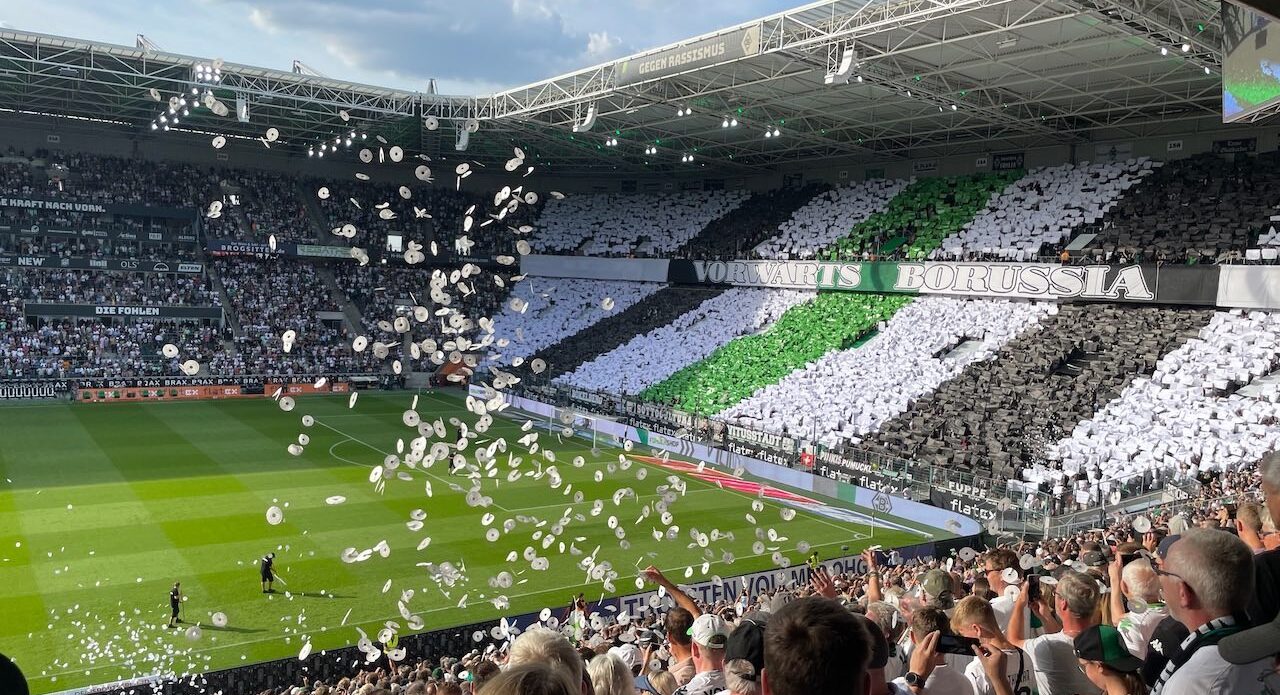
Glory years in the 1960s and 1970s built the club a large following, and while they haven’t won anything lately, they have a large and usually full stadium with an excellent atmosphere in a hotbed of German Fußball.
LOCATION: Mönchengladbach, Germany
CONTACT: borussia.de, +49 1806 1819 00, #DieFohlen
NICKNAMES: Die Fohlen or The Foals due to the low average age of players and their play style in the 1960s
History
Borussia Mönchengladbach was founded on August 1, 1900 after members of a previous sports association left to form their own, specifically focused on Association Football. The Borussia title in the clubs name is from the Latin spelling of Prussia, where the club was located at the time of its founding.
Prior to the first World War, Mönchengladbach went through several very successful seasons, while also bouncing between various home grounds. In 1912 Borussia dominated the league and defeated the southern district champions, as well as the Hessian champions.
WWI halted play for the all German clubs from 1916-1918, but play was resumed in August 1918. The club achieved a great victory in 1920 winning the West German championship final.
During WWII, German football was reformed, and Mönchengladbach found themselves playing in the district leagues. Play was halted, but resumed in 1946 and Mönchengladbach gained successive promotions in 1949 and 1950, putting them in the top flight, the Oberliga West. Nine years later the club won their first Oberliga title.
They continued their success in 1960 winning the West German cup, and later the DFB Pokal, their first national honor. In 1961 they took on the name Borussia VfL Mönchengladbach, after the city name was changed from München-Gladbach to Mönchengladbach. The new top flight of German football was formed in 1963, but their past results were not deemed enough to gain them entry so they ended up in the second tier.
For the 1965-66, Mönchengladbach secured their first promotion to the Bundesliga alongside Bayern Munich. The two clubs would go on to have a fierce battle for Bundesliga superiority in the late 60s and early 70s, culminating in Mönchengladbach’s successive title wins in 1970 and 71, making them the first German club to successfully defend their title.
This was just the beginning of the best period in Mönchengladbach’s history, as they went on to win the DFB Pokal in 1973, the league and the UEFA Cup in 1975. They would follow this up with another 2 successive league wins in 1976 and 77, making them the first German club to win the league 3 times in a row. They would also reach the UEFA Cup final secure their second international trophy by winning the UEFA Cup for in 1979 for the second time in 5 years. In the 1970s they would reach the UEFA Cup 4 times, winning two.
During the 1980s the club was forced to sell many players to deal with financial troubles, and this led to a lack of production from the team. They would reach the DFB Pokal final in 1992, but lost on penalties to their rivals Bayern Munich.
Things got worse in the late 90s when Mönchengladbach continued to struggle and finally were relegated to the 2. Bundesliga in 1999. They achieved promotion back to the Bundesliga after just 2 seasons, but continued struggle in the table. They would be relegated again in 2007, but came right back up the next season. Since this time, Mönchengladbach has remained a mid-table Bundesliga club looking for their next success.
2022–23 SEASON: 10th in the Bundesliga, 2nd Round of DFB Pokal
2023–24 SEASON:
Rivalries
Borussia shares their main rivalry with FC Köln, which is known as the Rhine Derby due to both clubs regional ties. Things really kicked off in 1964 when Cologne’s manager, Hennes Weisweiler, left the club for Mönchengladbach. Between 1970 and 1978 every league title was won by either Cologne, Mönchengladbach or Bayern Munich. This period in the 1970s was the best for both clubs, and for the rivalry in general. This rivalry was first played in 1961 and still exists to this day. Mönchengladbach still holds a slight edge in the overall record with 54 victories to Cologne’s 31.
Another prominent rival that Mönchengladbach has is German giant Bayern Munich. This rivalry really began in 1966 when the two clubs both gained promotion to the Bundesliga for the first time in their history. Both clubs gained massive succes in the 70s when Mönchengladbach won 5 league title to Bayern Munich’s 3. However, with Mönchengladbach’s decline in the 80s and 90s, Bayern has overtaken them in accolades and in the head to head record.
Women's Team
The women’s team associated with Borussia Mönchengladbach was formed in 1995 with significant help from the men’s manager at the time, Rolf Rüssmann. The club began in the district league and progressed through several promotions in their history, culminating in their promotion to the Bundesliga in 2016. They became a yo-yo club bouncing between the Bundesliga and 2. Bundesliga and they still continue to bounce between the 1st, 2nd and 3rd divisions.
Songs
The official club anthem is Eleven of the Lower Rhine, which is sang before every home game. Other songs include We are Borussia and The Soul Burns.
Here’s the pregame song, which is actually one of my favorites.
Stadium
Mönchengladbach plays their home games at Borussia-Park which opened in 2004, and has a capacity of just over 54,000. Borussia-Park replaced Bökelbergstadion, which was deemed unsafe and no longer satisfied the modern safety standards put forward by the league.
Tours are offered Friday to Sunday and can be booked on the club’s website.
Going to a Game at Borussia Mönchengladbach
GETTING THERE: Borussia-Park is the centerpiece of a large complex of fields and training facilities — which is also to say it’s not very interesting to visit otherwise. The best way to get there is a local train — covered by your game ticket — to Rheydt Central Station / Mittelstraße, then hop on a free shuttle bus to the stadium.
Details, links and other options can be found on the club’s website.
PUBS: There’s really nothing much around, except a standard biergarten / fan zone at the stadium. They do, however, have guys with beer-keg backpacks walking around to fill your cups, inside and outside the stadium.
GRUB: Same as above.
AROUND TOWN: Honestly, I have no idea. I stayed in Cologne, went to the game, and went back. If anybody knows of something interesting around, we would love to know about it!
Borussia Mönchengladbach Tickets
Tickets can be purchased directly from the club. Visit Borussia Mönchengladbach’s ticket page to learn more.
Photo Gallery


Videos

More About Borussia Mönchengladbach
Stay tuned, and subscribe to our free weekly newsletter.


