Club Profile
Wrexham
Until recently an ordinary, if very historic, non-league club, Wrexham has been swept up into the worlds of big money, television, marketing and celebrity.
LOCATION: Wrexham is in North Wales, about two hours by train from Manchester or 1.5 hours from Liverpool (both with a change on the way). It’s 3.5 hours and two changes from London.
CONTACT: 01978 89 1864, #WxmAFC
NICKNAMES: The Red Dragons
Wrexham History
The first and last parts of this story are what make Wrexham interesting and famous. In between is the story of a team below the second tier for almost their entire history, with a few famous victories and cup runs to brag about.
The club was founded in October 1864 in a local pub and played their first game right out back later that month. Both locations, The Turf and the Racecourse Ground, are still standing there, though the stadium (see below) has obviously been rebuilt a few times since.
There were a few name changes in the early days, and they played a few seasons in the 1880s in a different ground, but they are the fifth-oldest still-operating association football club in the world, the third-oldest professional club, and the oldest in Wales. They have played at the Racecourse under their current name continuously since 1883.
They started playing in the FA Cup that same year, and they joined the Football League in 1921. By then, they had already won the Welsh Cup many times, and their stadium had been hosting Welsh international matches for nearly 50 years.
They muddled about in the third and fourth tiers until the late 1960s, when two promotions saw them reach the Third Division (now League One), and their Welsh Cup wins saw them play in Europe a few times. They were in the FA Cup quarterfinals in 1974, the Cup Winners’ Cup quarters in 1976, and the Second Division for the first time in 1978. They lasted four seasons there but suffered successive relegations to land in the Fourth Division in 1983.
In the 1990s, while in the third tier, they famously beat defending league champions Arsenal in the FA Cup, and there were other famous cup runs during those days. But by the early 2000s, financial problems and a terrible owner almost sank them and the Racecourse.
They recovered from that after a supporters’ trust bought the club, but they landed in the Conference (now National League) in 2008. And there they sat for 15 years.
Then, sometime in 2020, actor Rob McElhenny saw “Sunderland til I Die” and thought, “I’d like to do something like that.” He got fellow actor Ryan Reynolds involved, and Welcome to Wrexham was born.
What followed, in one sense, was a familiar story: the new owners pumped money into the club, which achieved promotion and started climbing the league pyramid. This part is quite common. But in this case, it’s also a transformation of a normal football club into an international media star and travel destination. The Turf today is utterly packed for games, with many of the visitors recognizing regulars from the show, and a club that a few years ago could hardly attract 5,000 to a game now packs twice that in every game—and they’re expanding the stadium.
Last season they got themselves to the Championship, the first time in the history of England’s upper tiers a club was promoted three seasons in a row. Presumably they will win the Champions League in a couple of seasons.
With giant corporate sponsors (United Airlines in League One?) and the club touring the US and Australia, who knows how long all this will last. But it’s a lot of fun for now—if you can get to a game.
2024–25 SEASON: 2nd in League Two (promoted), 1st Round FA Cup, 1st Round League Cup
2025–26 SEASON: Championship (promoted in 2025)
Rivalries
By far the biggest is Chester, just 10 miles away—and in England, which only makes it worse. The Cross-Border Derby is intense, but it hasn’t happened since 2007, and Chester are now four leagues below. Also disliked are nearby neighbors Shrewsbury Town and Tranmere Rovers, as well as Welsh clubs Swansea City, Cardiff City, and Newport County. Recent intense competitions for promotion have created animosity with Notts County and Stockport County as well.
Women's Team
Also caught up in the new world, Wrexham AFC Women are becoming professional for the first time. They were founded in 2003, became part of the club in 2009, and now play in the Welsh Premier League. Home games are in a local stadium called The Rock. They have even toured the US and Asia!
Songs
The most unique one is “Wrexham is the name,” which includes the lines:
Fearless in devotion,
Rising to promotion.
To the ranks of mighty heroes,
Fighting foes in every land.
History only tells a story,
We are here to see your glory.
Stand aside, the Reds are coming.
Wrexham is the name.”
Stadium
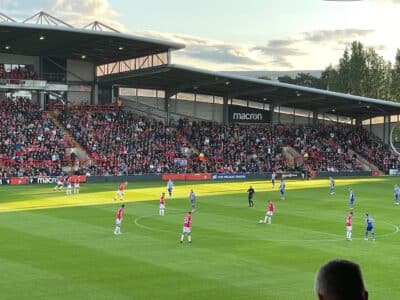
Even without all the recent changes—and maybe even more so without them—the Racecourse (Y Cae Ras in Welsh) is a wonderful old ground. It’s historic, cozy, and packed with charm as well as people. It is the world’s oldest ground still hosting internationals; the first Wales game there was in 1877.
Along one side is the Wrexham Lager Stand, built in 1972, and on the other is the main Macron Stand, which was expanded in 1999. Behind one goal is the Stōk Cold Brew Coffee Stand, home of the rowdy home support, and behind the other is a temporary stand. There, since 1952, stood the Kop, a large terrace which was demolished in early 2023. Plans for a 5,500-seater are in the works.
TOURS: Tours are available on certain days and cost £10 for adults and £5 for under-11s. Visit the club’s website for more information
Going to a Game at Wrexham
GETTING THERE: Once you get to town, it couldn’t be much easier. It’s about a five-minute walk from Wrexham General Station, which is a pretty good haul from almost anywhere else. From the station, just turn right for the ground and left for the town.
PUBS: Obviously, The Turf is the place to be. What it was like before, we couldn’t tell you, but today it’s packed inside and out, and there’s even a tent in the parking lot that does some overflow business. Otherwise, in town there are a few nice options, especially the Horse and Jockey with its 16th Century thatched roof. The Drunk Monk is a small, craft beer bar. The Golden Lion also dates to the 16th Century. The Long Pull had a good football crowd in it. And the Fat Boar is highly rated for food — though you’ll need reservations for game days.
GRUB: Check the Fat Boar and its outdoor area. Otherwise, it seems the usual options at the ground and in town. There is also a food court in a theater and community space called Tŷ Pawb.
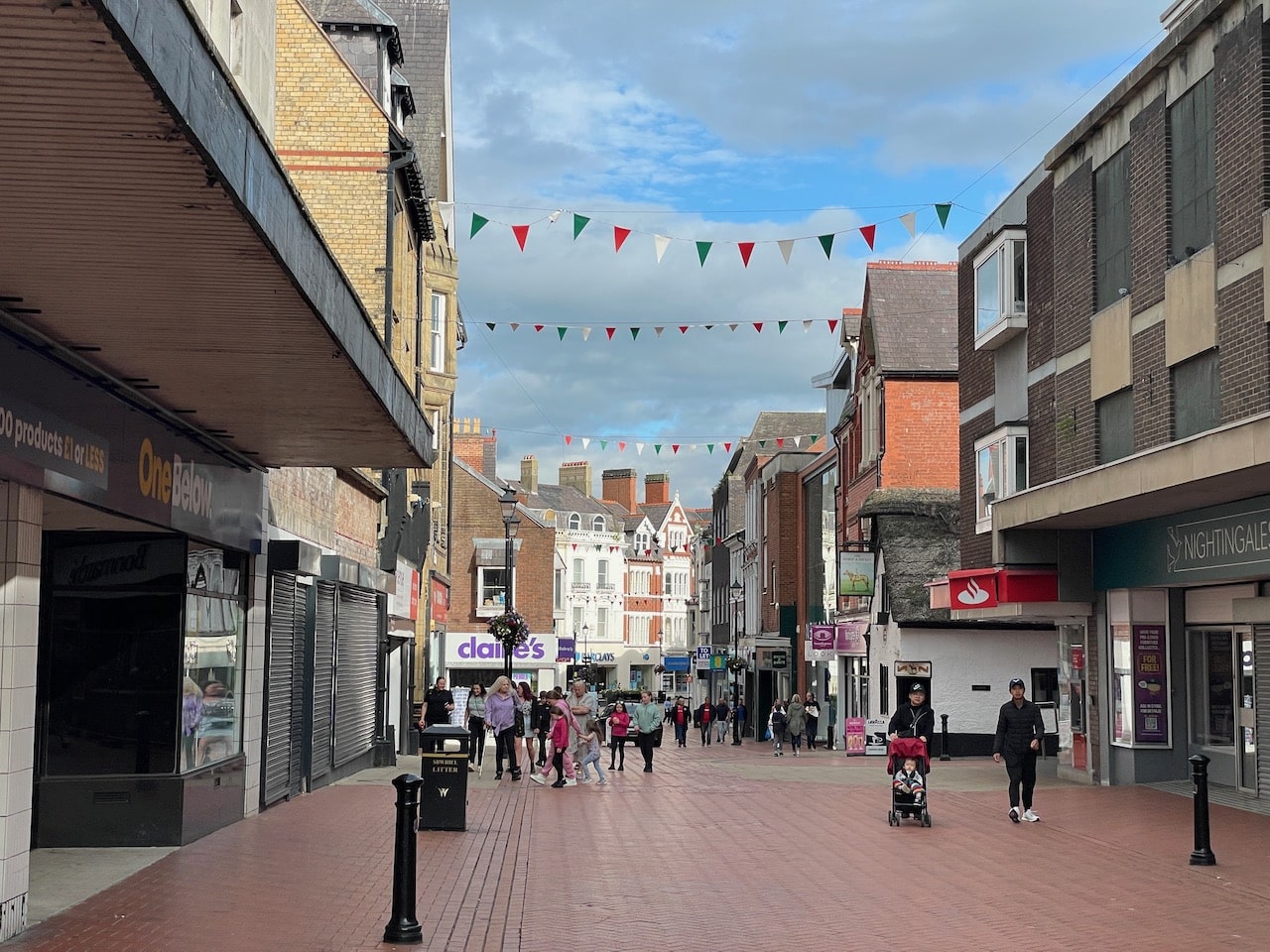
AROUND TOWN: From watching Welcome to Wrexham, you might get the impression Wrexham is some kind of run-down dump. And trust me, I have seen some run-down dumps in my British football travels — but Wrexham is decidedly not one of them.
The central area has some very nice old buildings, most notably St. Giles Church on a hilltop surrounded by medieval streets. The 1848 Butcher’s Market, inside which is a less-than-glamorous market, is nonetheless a nice building.
On a logistical note, if you’re in town for a night game, it really makes sense to spend the night, such is the late-night travel situation. There’s a Premier Inn right by the stadium, and a commenter on our website highly suggested the Lemon Tree Inn.
Wrexham Tickets
Three years ago, the answer to the question “How do you get Wrexham tickets” was to walk up to the ticket office and buy one. In their current state, though — and, we suspect, as long as the TV show is running — you will need a membership, patience, and some good luck. This should get easier when the stadium is expanded, but who knows what league they will be in then.
Check the blog post below for more.

Photo Gallery



Videos

More About Wrexham