Club Profile
Brighton and Hove Albion
Brighton and Hove Albion has become the model of a smaller club being run very well. It’s also one of the best short football trips outside London, as well: great town, lovely area, terrific new stadium.
LOCATION: Brighton (Hove is the town next door) is one hour south of Victoria station in London.
CONTACT: brightonandhovealbion.com, #BHAFC
NICKNAMES: The Seagulls. Albion, by the way, is based on an ancient word for “Britain”; two other league clubs use it: Burton and West Bromwich.
History
Brighton was founded in 1901 and bounced around the lower leagues until 1979, when they made the top division for the first time, staying there for four years. In 1983 they made the FA Cup final and drew with Manchester United, 2-2—a game that is most famous for a moment when Gordon Smith had a shot to win it in extra time but was denied by the United keeper. The moment lives on because it was a heartbreaker, and because the announcer famously said, “And Smith must score!” right before he didn’t. United won the replay, 4-0, and Brighton were later relegated as well, proving that soccer is utterly cruel.
By the mid-1990s, they were in real trouble, sitting at the bottom of the lowest division of the Football League. They were in such bad financial shape they had to sell their stadium. In the last game of the 1996-97 season, they needed at least a draw at Hereford to even stay in the league. At halftime they trailed 1-0. Enter the hero, Robbie Reinelt, who scored a last-minute goal to keep Brighton up and send Hereford down; the latter went out of business in 2014. Again, the game is cruel.
From there, Brighton began a long rebuilding process, but not before having to play two seasons at Gillingham FC’s stadium 75 miles away. They then spent 12 years at a local stadium about the size of some amateur club grounds. In the mid-2000s, to get out of financial trouble, the board had to pitch in £7 million, with another £2.5 million raised from, among other things, re-recording a hit song called “Tom Hark” by the Piranhas. You might think you don’t know this tune, but Google it. You will certainly know the melody if you’ve been to a few games in England. The Brighton version is called “We Want Falmer,” referring to the new stadium. Another thing they did to raise money: semi nude Christmas cards with the players. Seriously.
They then spent 10 years in the second tier, barely missing promotion in 2015–16, but they made it up for the 2017–18 season and are still there. When they lost their manager, Graham Potter, they just plugged in a new guy and rolled right along, finishing sixth in the league and qualifying for the Europa League—their first-ever trip to Europe. Last season they just missed out on another European tour.
2024–25 SEASON: 9th in Premier League, Quarterfinals FA Cup, 4th Round League Cup
2025–26 SEASON: Premier League (promoted in 2017)
Rivalries
Crystal Palace are their rivals, which is odd, because they are 45 miles apart—a long way in English soccer. So why do they hate each other? It goes back to the 1970s, when their two managers carried on an old rivalry from when they were teammates at Tottenham. In one season they played each other five times, including a double FA Cup replay that was settled, by all accounts, by a terrible referee decision. This, in turn, led to a Palace fan throwing coffee on the Brighton manager, who threw some words and hand signals back. You get the idea. It’s been tribal ever since.

Women's Team
Brighton and Hove Albion WFC play in the Women’s Super League, level 1 of the pyramid. Home games are at Broadfield Stadium in Crawley, also the home of Crawley Town FC.
Songs
Their anthem, the one they play when the teams come out, is an old marching tune called “Sussex by the Sea.” Not everybody gets into it, despite encouragement from the club. Here are some of the lyrics:
Good ol’ Sussex by the sea,
Good ol’ Sussex by the sea,
Oh, we’re going up to win the Cup,
For Sussex by the sea.
Stadium
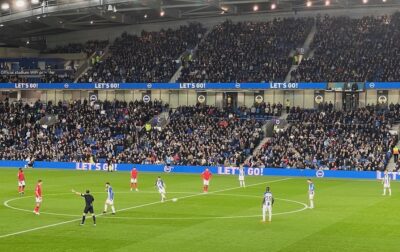
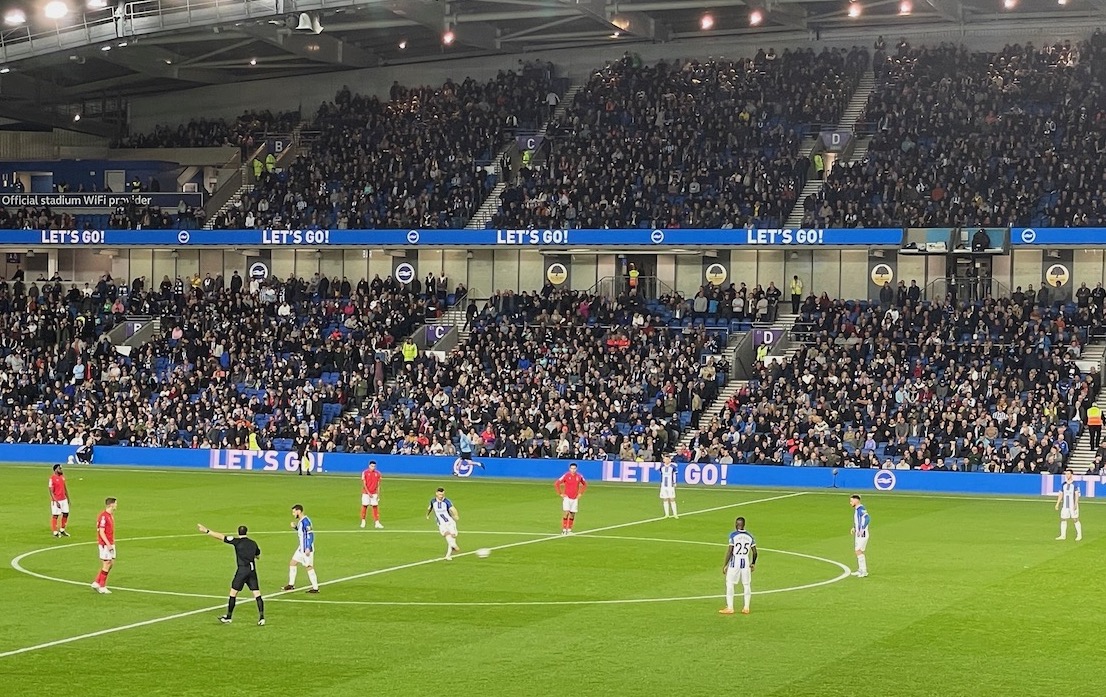
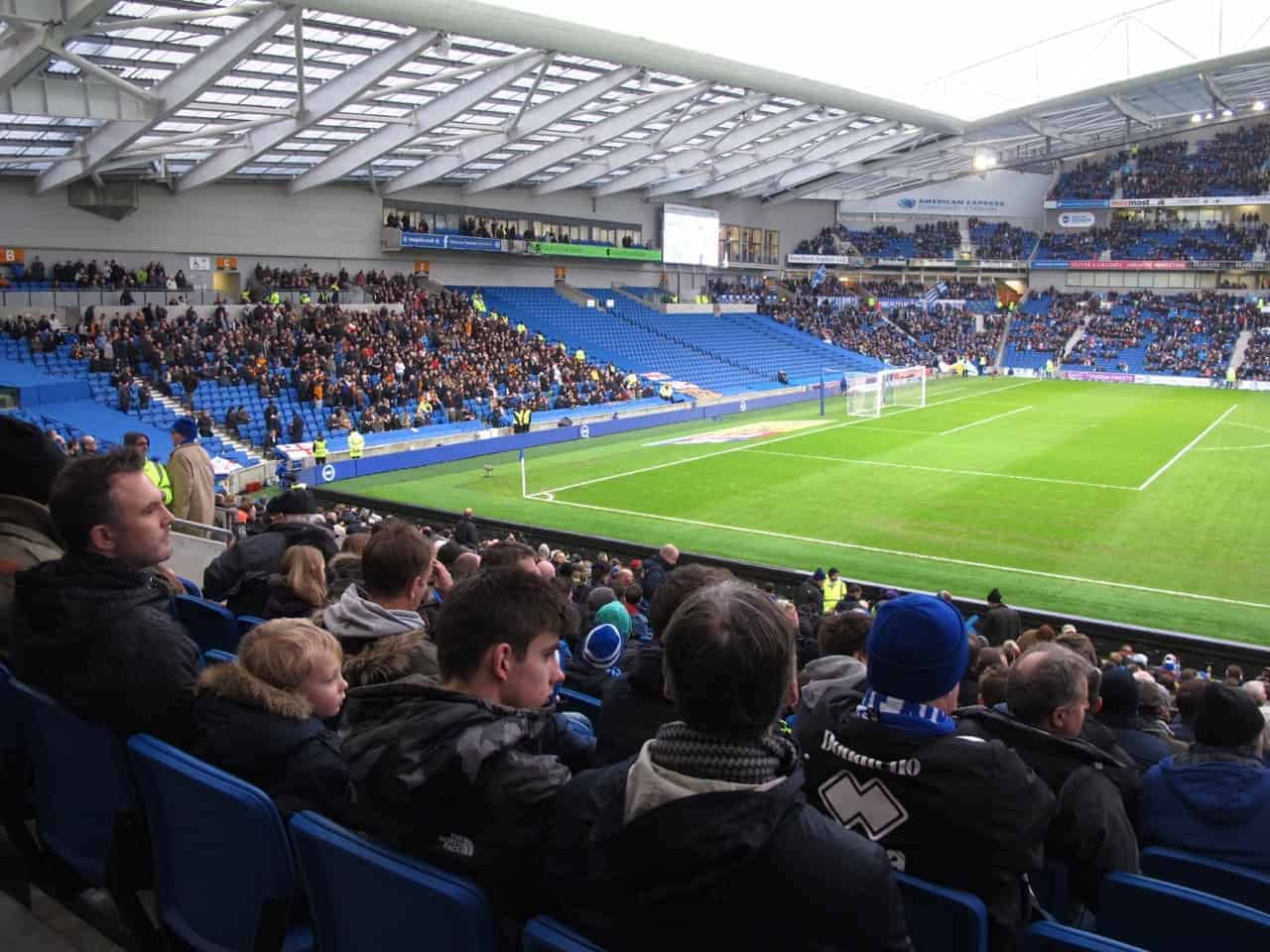
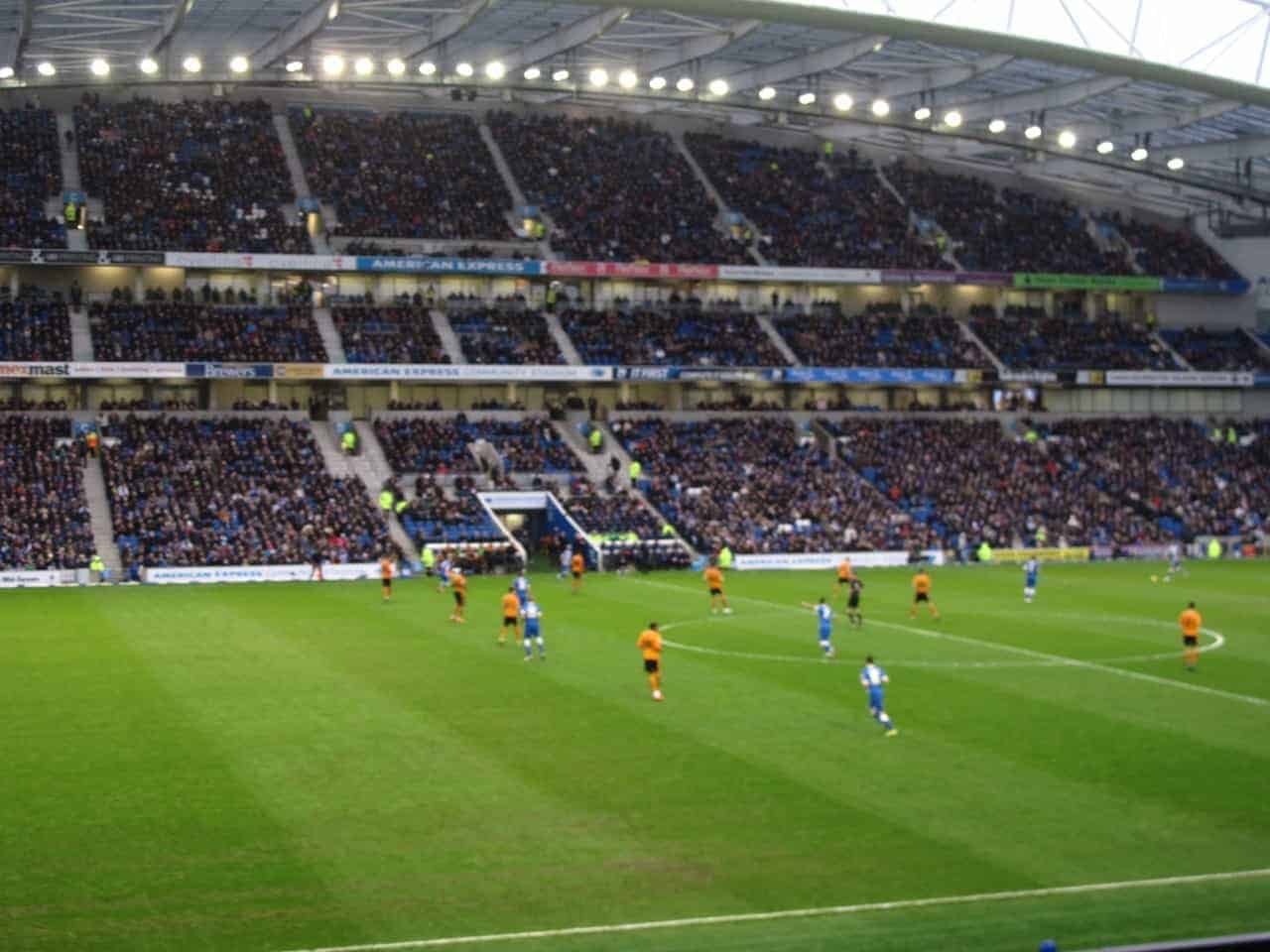
The fancy new American Express Community Stadium, with 30,750 seats, is five miles from the Brighton center in the suburb of Falmer. They have played there since 2011. Back then it had 22,000 seats, but it’s been expanded a few times. It has a somewhat unique and modern design that puts almost all the seats on the sides, and it gets high marks for being one of the better new stadiums around.
Away fans will be in the southeast corner behind a goal, home rowdies in the opposite north end.
TOURS: Tours are offered Saturday and Sunday. You can book a private tour on another day if there are four or more in your group. Adults are £15.
Going to a Game at Brighton and Hove Albion
GETTING THERE: You’ll want to take a train to The Amex, and it’s simple. From the main station in Brighton, take a train bound for Lewes and Seaford; the third stop is Falmer, right next to the stadium. Everybody on the train will get off there. Leaving is a bit tedious since everybody wants to get back on that train. I have heard of people staying in Lewes, a lovely town anyway, to make the trip less crowded. We’ve heard of people who stay in Lewes, which is lovely anyway, so they can go that way after the game.
PUBS: The Swan Inn on Middle Street is the only option close to the stadium, so it will be mobbed and you will need to show a home-section ticket to get in. But there are plenty of pubs right outside the Brighton station: the Evening Star, The Prince Albert, the Queen’s Head, and the Railway Bell are all good choices. Down by the beach look for the Victory Inn. Over by the Pavilion (see Around Town below), look for the cavernous and cool Ye Olde King and Queen.
GRUB: As is so often the case with these new places, there’s nothing by the stadium, so eat in town. There are all sorts of things in The Lanes (see Around Town below). Down at the beach, look for seafood at Tempest and the Regency; both have patios if by some miracle the weather is decent.
AROUND TOWN: Brighton is a fantastic place to visit, and as it’s just an hour from Central London, it’s a terrific day trip for a game. It is very much an old-school coastal town, with its Victorian trappings and seriously modern and hip vibes. Among the things to see:
- The Brighton Palace Pier, which opened in 1899, has an arcade, food, and even a roller coaster out at the end.
- The famous and very weird Royal Pavilion was built as a seaside retreat for the royalty in the 18th century. It has an outdoor skating rink in winter.
- The Lanes is a web of narrow streets filled with artisan shops and cafés and cool art.
- The British Airways i360 is a glass ball of an observation tower that rises 531 feet above the beach.
- The nearby historic town of Lewes (pronounced like “Lewis”) works well as a starting point before the game, as getting from there to the stadium involves fewer people. There you can find many historic buildings, charming old streets, an 11th-century castle, Harvey’s Brewery, and—if it happens to be the fifth of November—the biggest Bonfire Night celebration in the country. It’s pretty much Mardi Gras in flames.
- There is also a football club in Lewes, Lewes FC, which plays at tier 8 of the pyramid and, since their founding in 1885, in a ground called The Dripping Pan. Just had to get that in.
Brighton and Hove Albion Tickets
The last prices we saw for adult tickets ranged from £30 to £45. They can be tough for the bigger opponents, but a membership (£40) will help. It also gets you access to a season ticket resale area on the website. Some nice hospitality options are available, as well.
Photo Gallery


Videos

Fulham 1-2 Brighton 2017: Brighton Penalty
More About Brighton and Hove Albion