

Club Profile
Feyenoord
One of the three giants of Dutch voetbal, and the current champions, Feyenoord also play in a classic old stadium in a remarkably modern city.
LOCATION: Rotterdam, the Netherlands
CONTACT: feyenoord.nl, #feyenoord
NICKNAMES: De club aan de Maas (The Club on the Meuse)
History
The club was founded in the Feyenoord area of Rotterdam (it’s Feijenoord in Dutch) in 1908, and began using the neighborhood name as theirs in 1912. They won a couple of national titles and a Dutch Cup (now known as the KNVB Cup) in the 1920s and 1930s, which earned them a bigger following, leading to a move into their current home stadium in 1937.
When football went professional in Holland in the 1950s, Feyenoord joined the new top-tier Eredivisie, and they have been in it ever since.
The 1960s were glory years, with multiple league championships and deep runs in European competitions, culminating with an extra-time win in the 1970 European Cup Final over Celtic at the San Siro. They added the UEFA Cup in 1974, beating Tottenham in that two-legged final — this during a time when Dutch clubs were dominating Europe and their men’s national team made two World Cup Finals.
One interesting event in this time was the club’s signing of the legendary Johann Cruyff from Ajax, their archrivals. He was apparently mad at Ajax over contract negotiations, and what better way to get back at them? It was just for the 1983-84 season, but Feyenoord won a league-and-cup double with him — despite suffering an 8-2 loss to Ajax!
From then through the 1990s, they were a solid club that didn’t often win the league, as that was being dominated by Ajax and the third Dutch giant, PSV Eindhoven. But they experienced more European glory in 2002, when they started in the Champions League but dropped down to the UEFA Cup — the same thing still happens with the Europa League — and then made a run to the final. As it happens, the game was set for their home stadium, where a 3-2 win over Borussia Dortmund secured Feyenoord’s third European trophy.
Financial problems and scandals hit in the 2000s, and from 1999 to 2023 there was but one league win (in 2017) and three cups. The latest revival, happily for them coinciding with an implosion at Ajax, started with a run to the final of the new Europa Conference League in 2022 (they lost to Roma in Albania) and an Eredivisie championship in the 2022-23 season.
2024–25 SEASON: 3rd in Eredivisie; KNVB Cup quarterfinals; Champions League Round of 16.
2025-26 SEASON: Eredivisie (since 1954), Europa League
Rivalries
The biggest by far is with Ajax from Amsterdam, a game known as De Klassieker (“The Classic”). It is fueled by an ancient rivalry between the artistic, cosmopolitan Amsterdam and the working-class Rotterdam. As of the start of the 2023-24 season, they had played 203 times since 1921, with Ajax the winner on 94 occasions.
The biggest era of this rivalry was the 1970s, when the two clubs combined for four European trophies and their players dominated a Dutch team that made (but lost) the finals of both the 1974 and 19878 World Cups. Both of those finals, by the way, were played against the host countries of West Germany and Argentina.
There has been violence and trouble at the matches, even in recent times. Riots in 2005 at Feyenoord led to both clubs agreeing to ban away fans for five seasons. Even in the current season, a September 2023 game was suspended when Ajax fans — already in full protest mode over the meltdown status of their club on and off the pitch — threw flares onto the pitch at Ajax after Feyenoord took a 3-0 lead. They then went outside and clashed with police. The game was finished behind closed doors a few days later.
Feyenoord also hold a rivalry with the other Rotterdam clubs, Sparta and Excelsior. But Dutch football is hardly competitive outside the big three clubs, so these local rivals don’t seem to mean much to Feyenoord. Presumably that feeling is not shared.
RabonaTV on YouTube has a good video about the rivalry with Ajax:
Women's Team
Feyenoord Vrouwen was just founded in 2021 and now play in the top-tier Vrouwen Eredivisie. Home games are played at Rotterdam’s Sportcomplex Varkenoord, also the home of the men’s training facilities and the club’s academy and amateur side. Check the club’s website for details.
Songs
The club anthem is “Hand in Hand,” with 1961 lyrics over a 19th-Century German song. It sounds just like what you might expect an old German song adapted as a football song might sound like:
They also, after goals are scored, do a non-lyrical version of one of the songs from the Rocky movies. Not the main one — this one:
Stadium
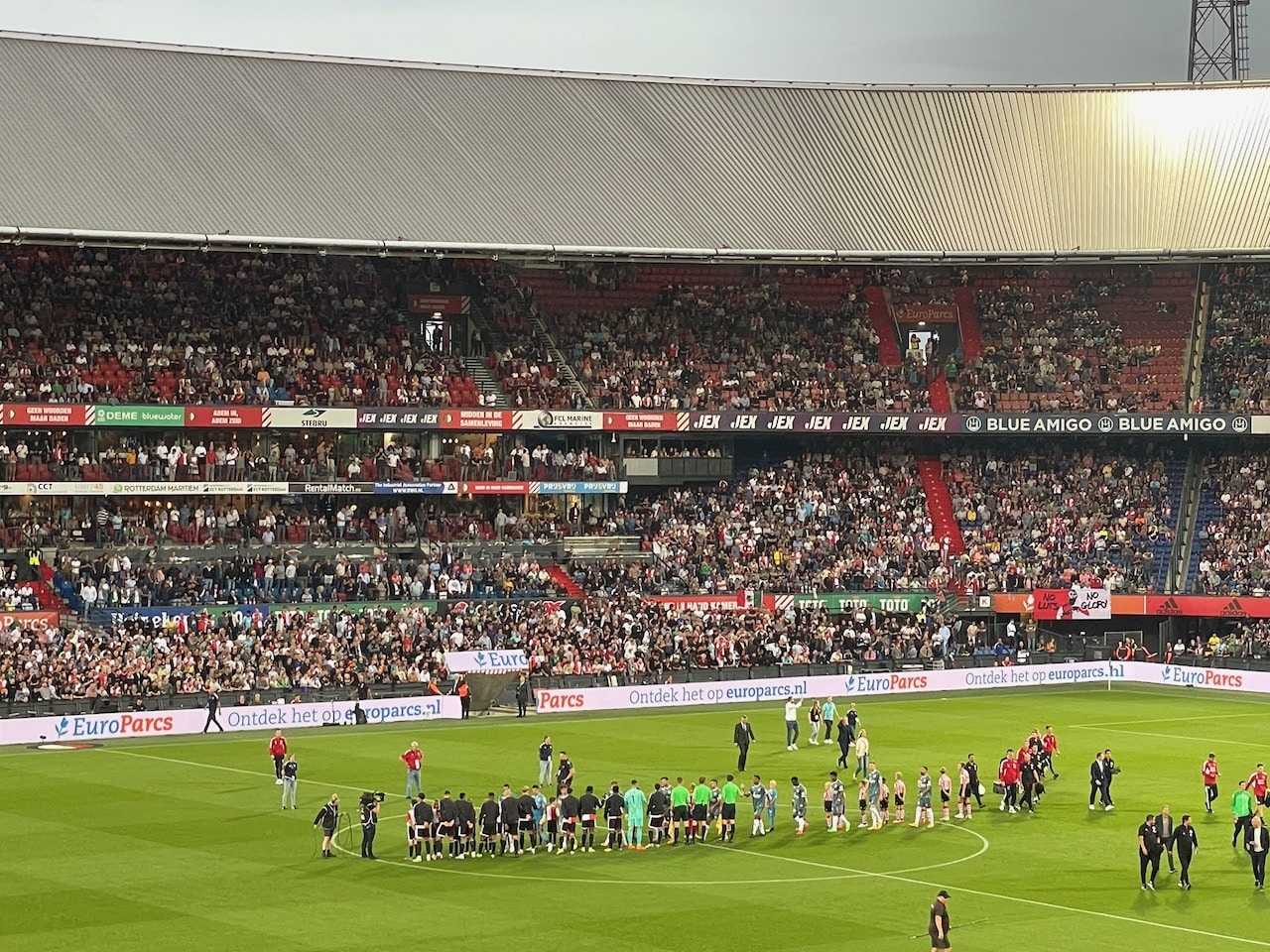
Officially Stadion Feijenoord, the club’s home is called De Kuip, which is Dutch for “the tub.” We assume this is because it shaped like a giant tub, but which oval stadium isn’t?
It was first built in 1937, then expanded in 1949 after the Germans occupied it during World War II and nearly tore it down for scrap metal. In 1994 it was converted to an all-seater and the capacity reduced to the current 51,000 or so. It got a little touch-up for the 2000 European Championships, and that’s it, meaning that it really feels like a classic old stadium compared to so many in Europe.
In addition to Euros 2000 games, it hosted the semifinals (which Holland lost to Croatia) and final of the 2023 UEFA Nations League.
TOURS start at 11 Euro and are available Wednesday through Sunday. See the website for details and booking.
Going to a Game at Feyenoord
GETTING THERE: There is a tram stop called Stadion Feijenoord right in front of the stadium. Get there from Rotterdam Central with tram line 23 towards Beverwaard. But, this being the Netherlands, you can also get there by water taxi! Check watertaxirotterdam.nl for details and to book ahead, which you will need to do. That drops you a five-minute walk from the stadium.
PUBS: There really is nothing in the way of pubs around the stadium. If you want a pregame pint, do it in town.
GRUB: There is a little cluster of thoroughly unspectacular places to eat between the stadium and the river, but as with having a drink, you’re much better off in the center before the game.
AROUND TOWN: Rotterdam was a revelation to me, as I didn’t know much of its history before arriving. I knew it was a major port and had a football club. And in fact it is Europe’s largest seaport, with a maritime history going back to the 13th Century.
What I didn’t know was that the Germans essentially destroyed it during World War II; when they couldn’t complete their invasion., they just bombed it to the ground. So after the war it had to be completely rebuilt — and they decided to become a modern, open city and bring in some of the world’s leading architects to do so. For example, they created, in 1953, the Lijnbaan, the first car-free shopping center in Europe.
Of particular interest are buildings like the Markthall, or Market Hall, with its soaring landscaped ceiling over many delicious food stalls, and the Cube Houses, which stand on their corners to maximize available space on the ground level. The Old Bay is well worth a walk around, as well, with its historic vessels and many places to eat and drink.
Also, I confess a great fondness for miniature trains and the like, and the hobby has a mecca of sorts in Rotterdam: Miniworld Rotterdam, very near the train station. It is massive, goes from day to night, and even features a spaceship landing over a miniature stonehenge.
Feyenoord Tickets
Tickets are available on the club website, and if they aren’t playing PSV or Ajax, you have a decent chance to get them. There’s also a ticket exchange for resales.
Groundhopper Soccer Guides sells tickets and hospitality to Feyenoord home games. Learn more about the options we offer below.

Photo Gallery




Videos
We didn’t really get any good ones on our visit, so here’s one from our favorite YouTube soccer channel.
More About Feyenoord
Stay tuned!


