

Stefan and Anna had it on their bucket list to watch some of the best…
The Madrid Derby: Real Madrid vs Atlético Madrid

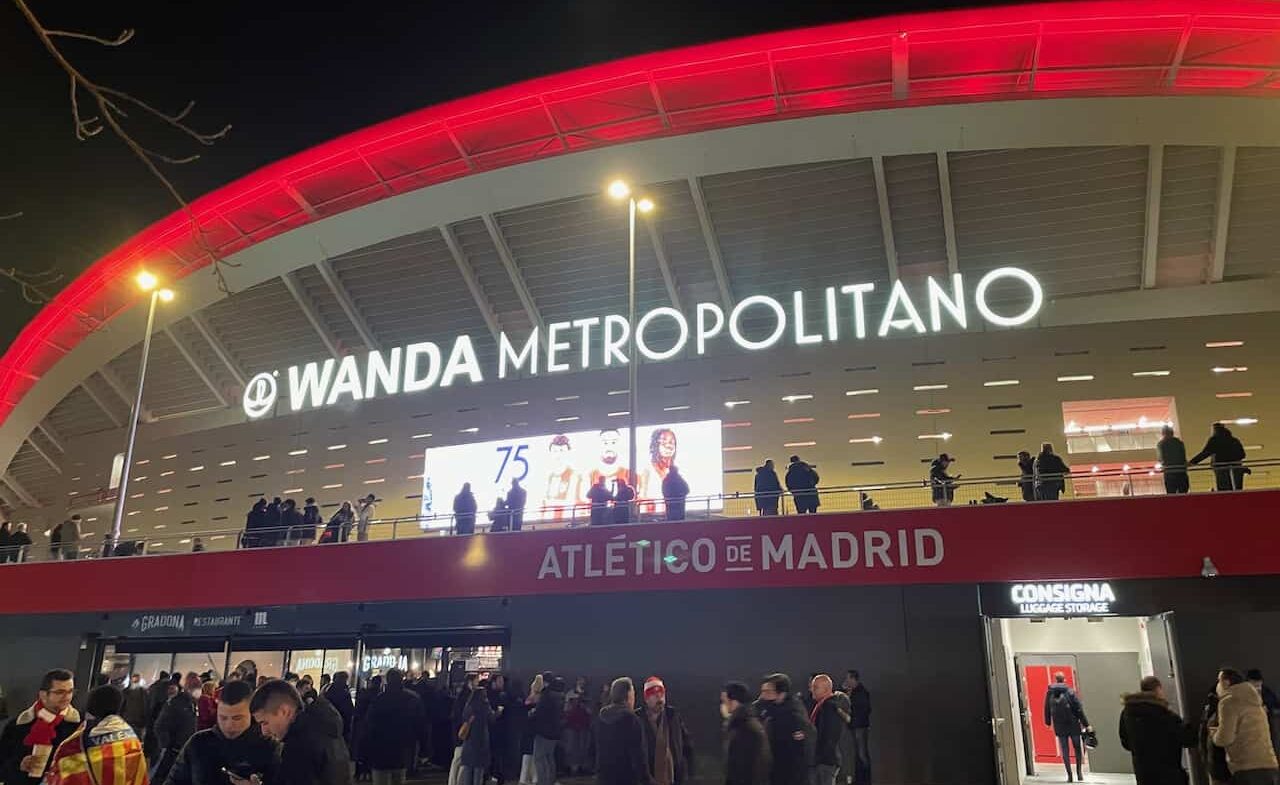
The Madrid Derby: A Rivalry 100 Years in the Making
The Madrid Derby, or El Derbi Madrileño, has a history that goes back more than 100 years, with intense matchups, legendary players, and high-stakes results. Put all of this in one of Europe’s most vibrant cities, and two of its most glamorous and famous stadiums, and the Madrid Derby is a game every groundhopper should see once in their lives.
In fact, we are authorized ticket sales agents for both Real Madrid tickets and Atlético Madrid tickets.
So let’s get to know this famous rivalry. First, we’ll start with a very brief history of each club.

The Santiago Bernabéu Stadium prepped and ready to go for Real Madrid’s Champions League semifinal game against Bayern Munich.
Real Madrid History
Founded as Madrid FC in 1902, the club became Real (“Royal”) Madrid in 1920 after receiving recognition from King Alfonso XIII. In 1932, they became the first Spanish club to win back-to-back league titles, but the Spanish Civil War and World War II soon disrupted football across Europe.
Everything changed in 1943 when former player Santiago Bernabéu became club president. Over the next 35 years, Bernabéu transformed Madrid into the world’s biggest club, rebuilding the stadium, modernizing the club’s infrastructure, and laying the foundation for decades of dominance.
Check out our full Club Profile of Real Madrid
When the European Cup launched in 1955, Madrid won the inaugural competition — then won it four more times in a row, a feat that has never been matched. Their legendary 7–3 victory over Eintracht Frankfurt in the 1960 final at Hampden Park in Scotland remains one of football’s defining performances. That side featured icons like Alfredo Di Stéfano, Ferenc Puskás, Francisco Gento, and Raymond Kopa.
Real Madrid have won a record 14 European Cups/UEFA Champions League titles, including three consecutive crowns from 2016 to 2018, as well as a record 35 La Liga championships.
Their list of stars reads like football royalty: Zinedine Zidane, Raúl González, Cristiano Ronaldo, David Beckham, Luis Figo, Sergio Ramos, Roberto Carlos, Kaká, Xabi Alonso. There’s a reason many of their teams became known as the Galácticos.
Atlético Madrid History
Atlético de Madrid were founded in 1903 by students in Madrid who viewed the club as a youth branch of Athletic Club Bilbao. By 1911, Atlético had begun forming their own identity, adopting the red-and-white stripes that would become iconic.
In 1921, Atlético became fully independent from Athletic Bilbao and soon found success, reaching the Copa del Rey final and later joining the inaugural La Liga season in 1929.
Check out our full Club Profile of Atlético Madrid
During the Spanish Civil War and World War II, the club merged with Aviación Nacional, a team linked to the Spanish Air Force, becoming Athletic Aviación de Madrid. The merger produced Atlético’s first league titles in 1939–40 and 1940–41. In 1947, the club dropped the military connection and adopted its current name.
Another successful era followed under legendary manager Helenio Herrera, who guided Atlético to back-to-back La Liga titles in 1949–50 and 1950–51. The club added several more league trophies during the 1960s and 70s.
But Atlético later declined. The youth academy closed in 1992, and relegation finally came in 2000 after 63 consecutive seasons in La Liga. The club spent two years in the Segunda División before returning to the top flight in 2002.
Since 2012–13, Atlético have reestablished themselves as one of Spain’s elite clubs, winning La Liga titles in 2014 and 2021 while regularly competing in the Champions League.
Much of that resurgence is tied to manager Diego Simeone, the former Atlético midfielder who has led the club since 2011. His intensity and defensive identity transformed Atlético into a true rival to both Real Madrid and Barcelona.
Origins of the Madrid Derby
The Madrid Derby between Real Madrid and Atlético Madrid is historically driven by class, politics, identity, and more than a century of intense games.
The roots of the rivalry stretch back to the early 1900s, when Real Madrid quickly became the dominant force in the Spanish capital by absorbing smaller clubs and signing away top players. Atlético, founded in 1903 as a branch of Athletic Bilbao, became one of the few clubs capable of resisting Real’s growing influence. Supporters of clubs that disappeared often gravitated toward Atlético, creating early resentment toward the “royal” club.
During Spain’s Franco era, the derby took on a strong political and social meaning as well. Atlético were briefly associated with the military through their merger with Aviación Nacional, while Real Madrid later became viewed as the establishment club as the regime embraced the team’s European success as a symbol of Spanish prestige. Atlético fans responded by embracing an outsider identity, often portraying themselves as the club of the working class in contrast to Real Madrid’s wealth, glamour, and power.
The divide was also geographic and cultural. Real Madrid’s Santiago Bernabéu stood in Madrid’s affluent northern financial district, while Atlético’s old Vicente Calderón sat beside the Manzanares River in a more industrial part of the city. Real became the global powerhouse; Atlético became the proud local challenger.
On the pitch, the rivalry intensified through decades of dramatic clashes. Real dominated Europe, winning a record number of European Cups and Champions League titles, while Atlético built a reputation for resilience and defiance. The clubs’ first European meeting was in the European Cup semifinals in 1959, beginning a long history of emotionally charged encounters, including multiple domestic finals and two heartbreaking Champions League final defeats for Atlético in 2014 and 2016.
Despite the imbalance in trophies and resources, Atlético have repeatedly challenged Real’s dominance, especially under Argentine manager Diego Simeone, whose fiery leadership restored the club as a European force. Today, the Madrid Derby stands as one of football’s fiercest rivalries, a clash that regularly shapes title races in Spain.
Overall State of the Madrid Derby
As of the end of the 2025-26 season, Real Madrid and Atlético Madrid have played 243 times since 1906, with Real Madrid winning 119 to Atlético’s 61, with 63 draws.
The derby continues to be a hotly contested affair for supporters and clubs alike, and with both teams in La Liga, you can expect this matchup to occur at least twice a year for years to come.
When is the Next Madrid Derby?
The 2026-27 La Liga season begins the weekend of August 16, and we expect to know the La Liga fixtures by around the first of July. Given that both teams are, as usual, in the Champions League and the Copa Del Rey, they could well meet in one or both of those competitions, as well.
Real Madrid vs Atlético Madrid Tickets
Groundhopper Guides is a registered ticket agent for both Real and Atlético, so whenever they play, we can offer tickets.
Read more about our Real Madrid tickets and our Atlético tickets, or just fill out the form below to get a quote for whichever of their home games you want.
Related Posts


Post Comments